

 3632
3632  2577
2577China has established the world’s largest housing security system, characterized by stratified coverage of beneficiary groups, coordinated provision by multiple actors, and parallel implementation of rental-based and sale-based allocation mechanisms. Grounded in the institutional evolution and practical experience of China’s housing security system, this paper systematically reflects on the limitations of applying Western housing security frameworks within the Chinese context. It further proposes a strategy for constructing an indigenous knowledge system for housing security in China from the perspectives of concepts, theories, and models. At the conceptual level, this paper advocates a structurally grounded and hierarchically organized taxonomy. “Affordable housing” is defined as the overarching institutional category, within which two principal branches—rental-based and sale-based provisions—are distinguished. They are further specified into concrete subtypes, including public rental housing, government-subsidized rental housing, shared-ownership housing, and closed-management affordable housing. This paper also emphasizes the standardization of terminology and its capacity for cross-contextual dialogue. At the theoretical level, this paper advances a core framework summarized as “one center, dual attributes, and three objectives”. “One center” refers to a people-centered orientation toward common prosperity, clarifying the fundamental question of “housing security is provided for whom”. “Dual attributes” highlight the dialectical unity of equity and efficiency, addressing the central tension between social protection and economic development. “Three objectives” encompass a progression from ensuring basic shelter (subsistence goal), to achieving adequate and livable housing (development goal), and ultimately to promoting shared prosperity (collective goal). Together, these elements form an internally coherent explanatory logic for the housing security system. At the level of practical models, this paper adopts a problem-oriented approach and focuses on three pressing issues in China’s current housing security practice. First, supply-demand alignment, which involves resolving structural mismatches in beneficiary identification, spatial distribution, and policy instrument design. Second, fiscal sustainability, which calls for an analytical framework covering cost estimation, financing mechanisms, asset management, and risk monitoring, with a particular focus on innovative approaches such as converting existing housing stock into affordable housing. Third, governance modernization, which emphasizes the development of a multi-actor governance system through improvements in organizational structures, coordination mechanisms, and performance evaluation. This paper provides theoretical guidance for further improving China’s housing security models and offers a “Chinese solution” to housing governance challenges in other developing countries.
 / Journals / Journal of Shanghai University of Finance and Economics
Journal of Shanghai University of Finance and Economics
LiuYuanchun, Editor-in-Chief
ZhengChunrong, Vice Executive Editor-in-Chief
GuoChanglin YanJinqiang WangWenbin WuWenfang, Vice Editor-in-Chief
Constructing an Indigenous Knowledge System for Housing Security in China: Concepts, Theories, and Models
Journal of Shanghai University of Finance and Economics Vol. 28, Issue 04, pp. 19 - 31 (2026) DOI:10.16538/j.cnki.jsufe.2026.04.002
Summary
References
Summary
Cite this article
Qiao Bei, Yao Lingzhen, Zhang Li. Constructing an Indigenous Knowledge System for Housing Security in China: Concepts, Theories, and Models[J]. Journal of Shanghai University of Finance and Economics, 2026, 28(4): 19-31.
Export Citations as:
For
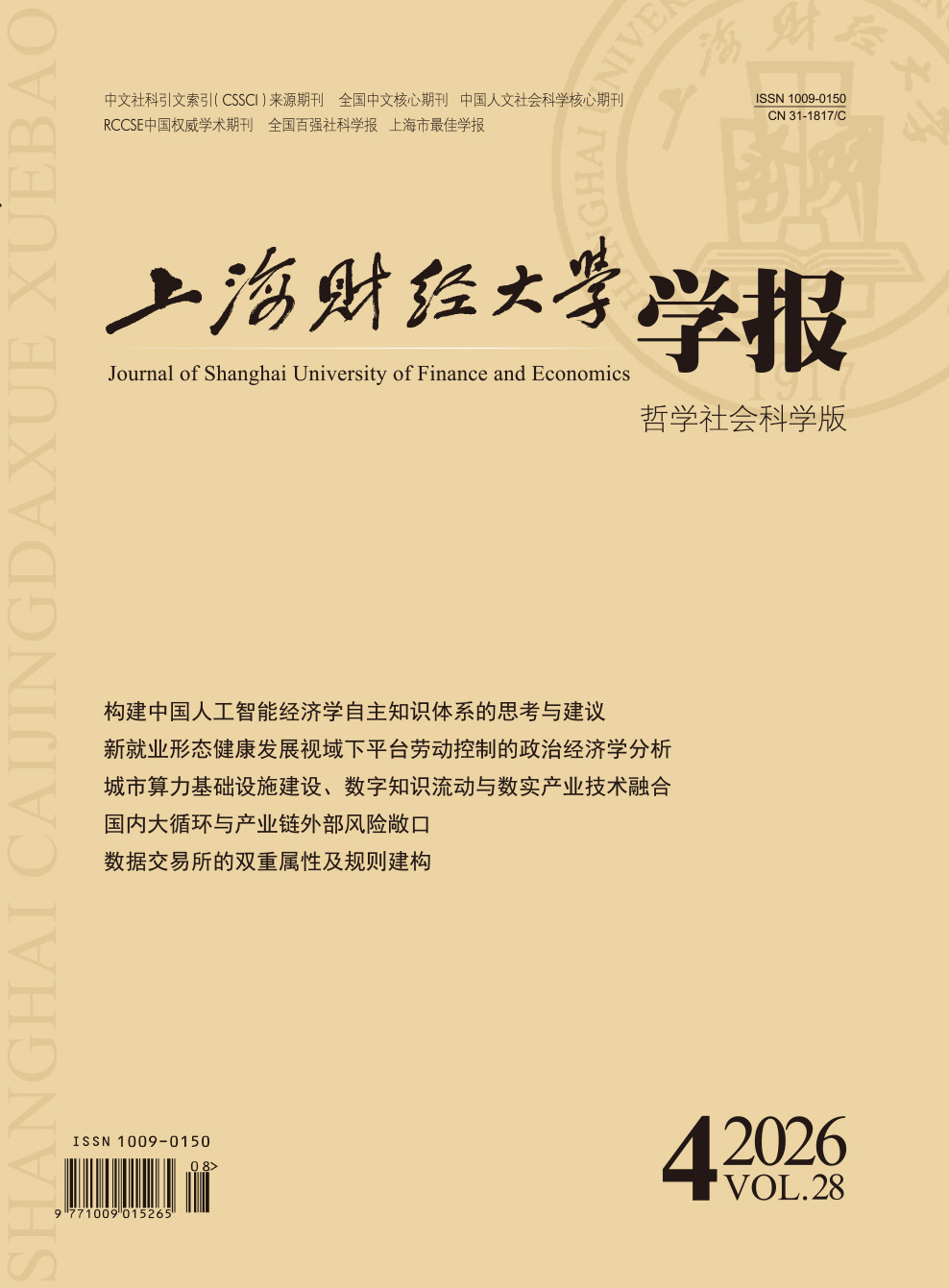
ISSUE COVER
RELATED ARTICLES