

 5413
5413  8222
8222In recent years, as market expectations have relatively weakened, firms are facing increasing uncertainty. R&D strategies are becoming more conservative, making the problem of “quantity over quality” particularly prominent. The large-scale tax cut policy has become an important tool to boost market confidence and unleash economic vitality. However, short-term preferential policies are relatively intensive, which may not be conducive to the formation of sustained and stable tax preferential expectations for firms. Based on the intersection of two types of VAT refund policies in 2018 and 2019, this paper compares the differences in the effects of short-term tax incentives and long-term sustained tax incentives, and explores the impact and mechanism of sustained tax preferential expectations on firms’ innovation behavior. The results indicate that the long-term VAT refund policy has a significant improvement effect on the quality of firm innovation, while the short-term VAT refund policy only has a significant improving effect on the quantity of firm innovation. The findings still hold after a series of robustness tests. Mechanism testing shows that the long-term VAT refund policy can create sustained tax preferential expectations, reduce precautionary savings of firms, enhance their long-term investment tendency, and thus promote high-quality innovation. Heterogeneity analysis reveals that the impact of tax preferential expectations on innovation behavior is more significant when firms are in non-declining periods and in regions with lower tax uncertainty, higher marketization, and stricter intellectual property protection. This paper provides a reasonable reference for creating a transparent, stable, and predictable tax environment as well as boosting corporate investment confidence.
 / Journals / Journal of Shanghai University of Finance and Economics
Journal of Shanghai University of Finance and Economics
LiuYuanchun, Editor-in-Chief
ZhengChunrong, Vice Executive Editor-in-Chief
GuoChanglin YanJinqiang WangWenbin WuWenfang, Vice Editor-in-Chief
Sustained Tax Preferential Expectations and Firms’ Innovation Behavior: Evidence from Intersection of Two Types of VAT Refund Policies
Journal of Shanghai University of Finance and Economics Vol. 27, Issue 06, pp. 49 - 63 (2025) DOI:10.16538/j.cnki.jsufe.2025.06.004
Summary
References
Summary
Cite this article
Liu Jindong, Li Yimeng. Sustained Tax Preferential Expectations and Firms’ Innovation Behavior: Evidence from Intersection of Two Types of VAT Refund Policies[J]. Journal of Shanghai University of Finance and Economics, 2025, 27(6): 49-63.
Export Citations as:
For
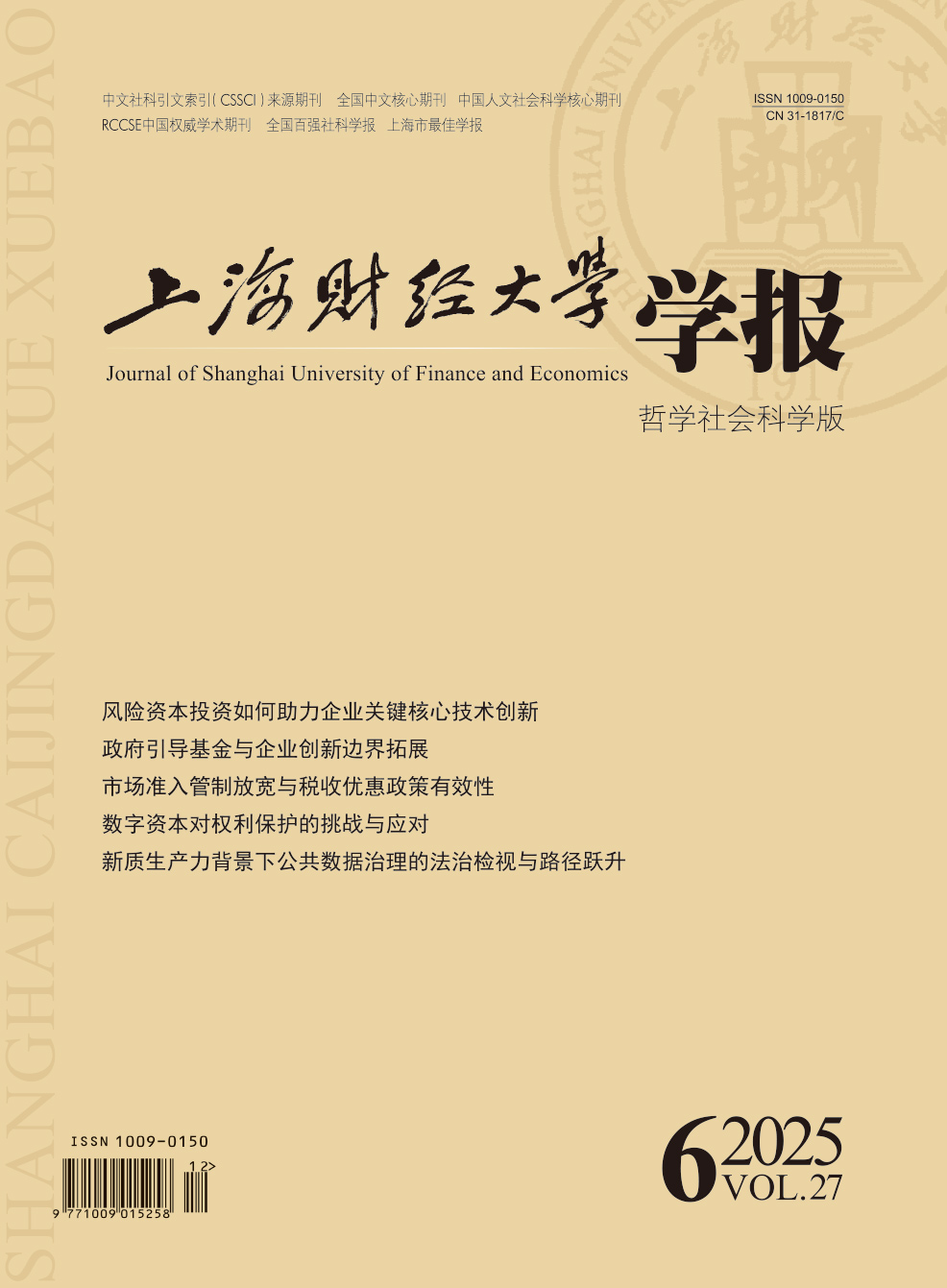
ISSUE COVER
RELATED ARTICLES