

 3940
3940  3370
3370The 15th Five-Year Plan adopted at the Fourth Plenary Session of the 20th Central Committee of the Communist Party of China proposed to “promote the healthy development of flexible employment and new forms of employment”, and emphasized that “those who work hard should be allowed higher incomes”. Ride-hailing is a typical representative of new forms of employment in the era of the digital economy, and its healthy development is directly related to the vital interests of a large number of flexible workers. This paper takes ride-hailing and taxi drivers in Beijing, Wuhan, Zibo, and Wuhu as research subjects. Through field research and cross-industry comparison, it is found that platform labor control deepens the substantive subordination of labor to capital through the piece-rate wage system from three dimensions: labor standards, labor intensity, and labor supervision, and algorithms achieve comprehensive control over the labor process. Under this mechanism, drivers are forced to accept low-yield orders, extend their online hours, and strive for positive reviews in order to maintain account weight, forming a widespread behavior of “account maintenance”. This behavior leads to three consequences: First, there is a continuous disconnect between labor input and income return, making it difficult to achieve “the more you work, the more you earn”; second, the experience and data accumulated during the labor process are integrated and used by the platform, and drivers fail to obtain corresponding returns; third, the space for free development is continuously narrowed due to time constraints, and long-term overtime work makes it difficult for drivers to achieve skill improvement and career transformation. Further analysis shows that there is a disconnect between current institutional supply and platform practices: Beijing faces a dilemma of gray operation and sunk costs due to strict household registration restrictions and high compliance thresholds; cities such as Zibo and Wuhu are caught in a catch-all type of involution due to flexible regulation and insufficient institutional protection; in Wuhan, under the multiple overlaps of compliance, market involution, and technological substitution, drivers’ pressure from “account maintenance” is particularly prominent. These differences indicate that the interaction between local governance strategies and platform algorithm logic varies, resulting in differentiated labor control outcomes. Under the socialist market economy system, solving the dilemma of platform labor control requires breaking the algorithmic black box and improving the governance system from three levels: algorithm transparency, cost sharing, and labor process protection, so that workers in new forms of employment can truly enjoy the right to decent work.
 / Journals / Journal of Shanghai University of Finance and Economics
Journal of Shanghai University of Finance and Economics
LiuYuanchun, Editor-in-Chief
ZhengChunrong, Vice Executive Editor-in-Chief
GuoChanglin YanJinqiang WangWenbin WuWenfang, Vice Editor-in-Chief
A Political Economy Analysis of Platform Labor Control from the Perspective of the Healthy Development of New Employment Forms: Taking the Phenomenon of “Account Maintenance” in Ride-hailing as an Example
Journal of Shanghai University of Finance and Economics Vol. 28, Issue 04, pp. 32 - 44 (2026) DOI:10.16538/j.cnki.jsufe.2026.04.003
Summary
References
Summary
Cite this article
Liu Yong, Zhang Ruiqi, Zhou Shaodong. A Political Economy Analysis of Platform Labor Control from the Perspective of the Healthy Development of New Employment Forms: Taking the Phenomenon of “Account Maintenance” in Ride-hailing as an Example[J]. Journal of Shanghai University of Finance and Economics, 2026, 28(4): 32-44.
Export Citations as:
For
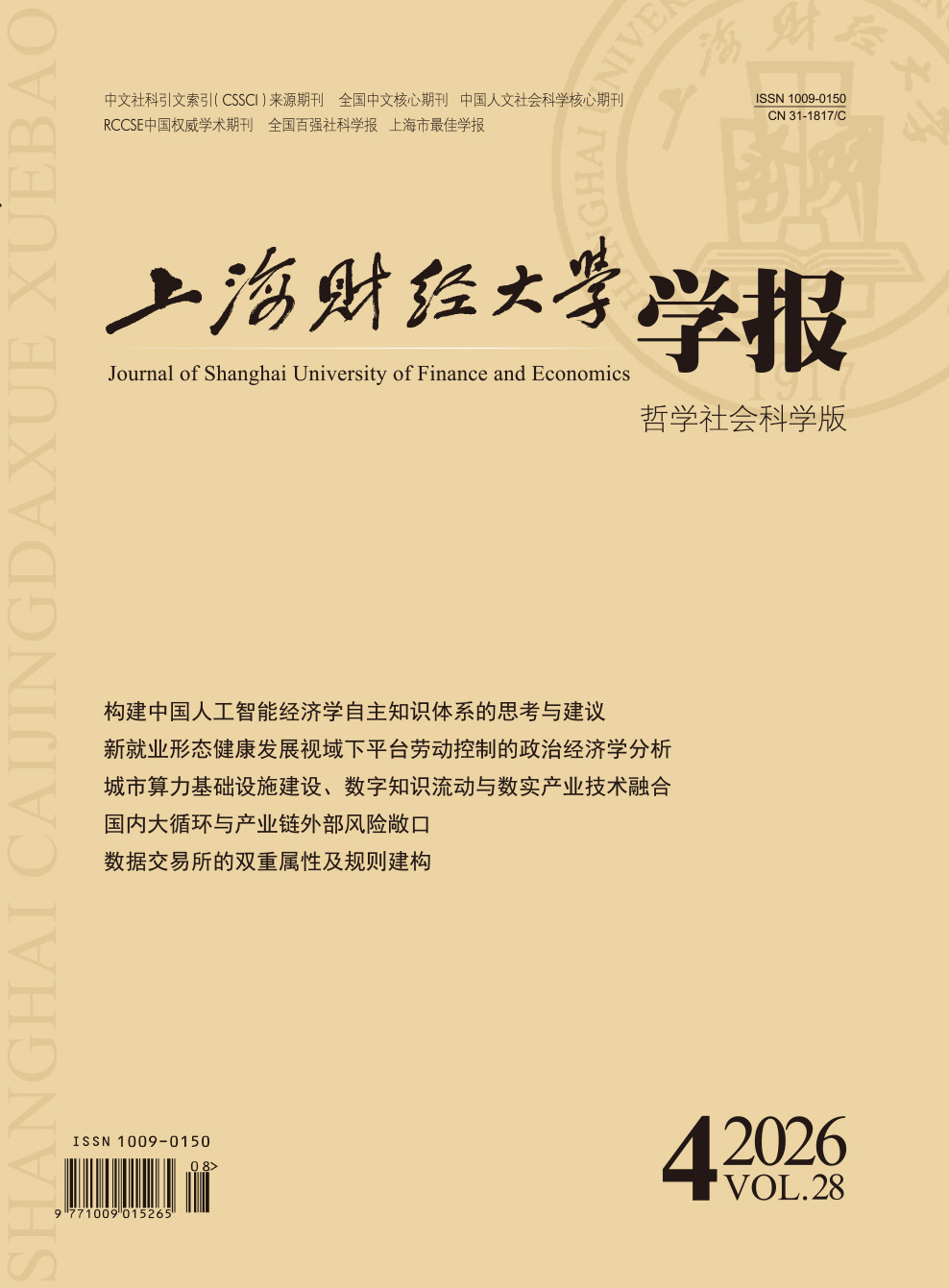
ISSUE COVER
RELATED ARTICLES